Plus500 Trading & Investing
- 4.4
- Rating
- 500.00K
- Installs
- Free
- Price

 Analysis by App-foxy
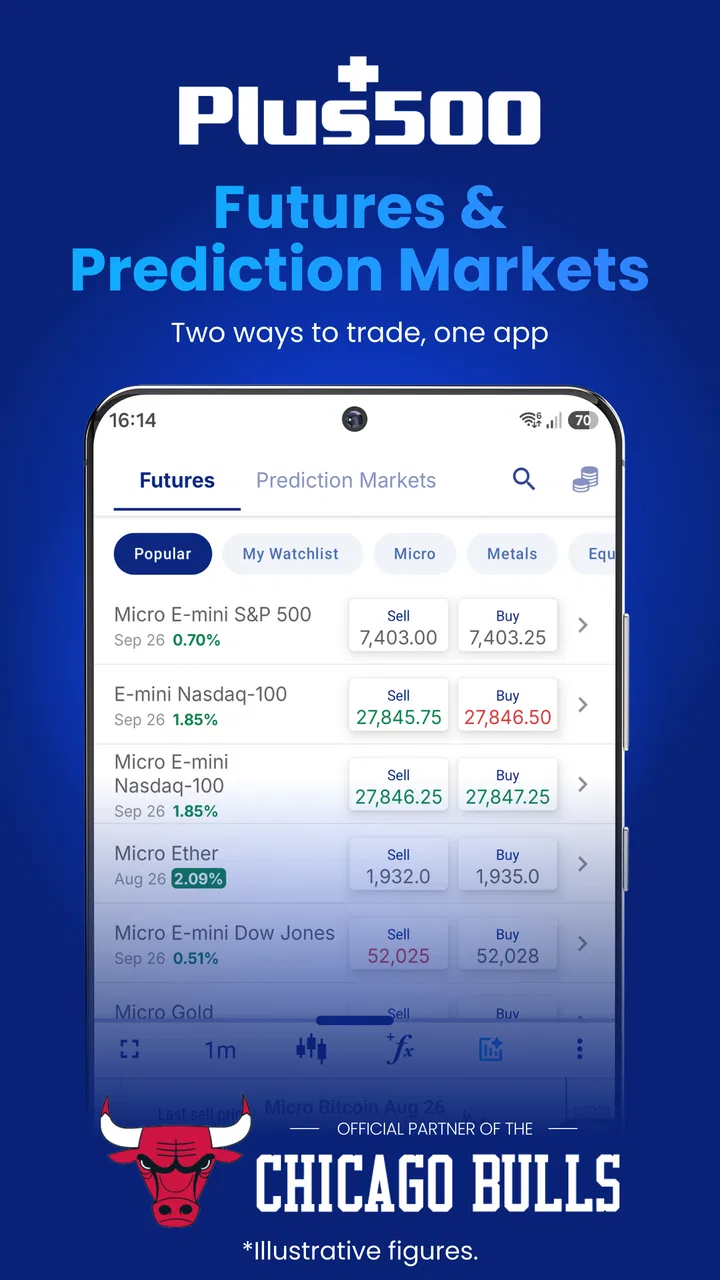
My first impression of Plus500 Trading & Investing was that it is designed to get me from curiosity to a market screen with very little ceremony. It is a free finance app from Plus500 Trading, aimed at people who want to trade or invest around instruments such as Bitcoin, Ethereum, foreign exchange, the S&P 500 and the Nasdaq. That broad scope gives it immediate appeal, but it also creates an important question: does it remain useful after the excitement of watching prices move wears off?
In my experience, the answer depends less on how often you want to trade and more on whether you can build a disciplined routine around it. The app can be a practical mobile companion for checking markets and making decisions when you are away from a desktop. It is not a substitute for learning how financial instruments work, and I would not treat its clean presentation as evidence that trading itself is simple. The interface may reduce friction, but it cannot remove market risk.
The app is rated for Everyone, runs on Android from version 8.0 onward, and has reached over half a million installs. Its average rating is 4.4 from roughly 3.8 thousand ratings, with about 677 written reviews. Those figures suggest a reasonably established mobile presence, although they should not be confused with proof that it suits every type of trader. The current version is 26.8.0, and the app was released on December 27, 2022.
You May Also Like

 Blood Strike: 2.5 Anniversary
Blood Strike’s Loadouts Turn Every Drop Into a Tactical Gamble
A close look at Blood Strike’s custom loadouts: how fast access to signature weapons reshapes its battle royale rhythm, rewards preparation, and narrows the gap between fights.

 Pandora - Music & Podcasts
Pandora’s Music Is Easy to Start, but Harder to Recover
Pandora’s strength is its low-effort path from a seed to a station. Its weak spot is how much confidence it asks you to place in connection, setup, and quiet recovery.

 8 Ball Pool
 Is Built on Rivalries, Rematches, and Routine
A close look at the rivalries, rematches, shared routines, and unanswered safety questions that turn a quick pool match into a persistent mobile community.

 Samsung Music
’s Quiet Strength Is Playing What You Already Own
Its reach comes less from spectacle than from dependable access to a personal library. That simplicity is both the app’s strongest retention engine and its ceiling.

 AccuWeather: Weather Radar
AccuWeather Review: A Quick, Clear Forecast for Everyday Decisions
For everyday plans, the best forecast is the one you can understand quickly. AccuWeather makes rain timing, radar, and local conditions easy to act on, with a few trade-offs.

 Hill Climb Racing
Why Hill Climb Racing Still Turns Crashes Into One More Run
A tiny car, a bumpy hill and one more upgrade: Hill Climb Racing keeps resurfacing because its simple chaos makes every near-miss feel personal.
More From Our News Desk



From first-week appeal to long-term usefulness
I find that the move from first-week curiosity to lasting usefulness depends on whether the app becomes part of a deliberate routine, rather than a reason to check prices whenever I have a spare moment. That distinction also shapes how comfortable the experience feels across different needs and settings. Next, I look at how readability and navigation affect that everyday routine.
Why the first few sessions feel convincing
The strongest early attraction is concentration. Instead of jumping between separate apps for cryptocurrency, currency markets and major indices, I can use one finance-focused place to follow several areas that often dominate the news. That makes the first week feel productive: I can create a watch habit around the markets that actually interest me rather than opening a general news app and trying to translate headlines into possible price movements.
That convenience is especially useful in an everyday situation. Imagine I am commuting, hear a report about a sharp move in technology stocks, and want to inspect the Nasdaq rather than rely on a headline. A mobile trading app lets me check the instrument, compare it with another market I follow, and decide whether the event deserves attention or merely noise. The value is not that the phone predicts the next move; it is that the decision-making process becomes available at the moment the question occurs.
The range of markets can also help a beginner understand that different assets do not behave in identical ways. Bitcoin and Ethereum may attract attention for their volatility, while a broad index can feel more connected to large-company sentiment, and foreign exchange can react to economic news from several regions. I like having those contrasts in one app because they encourage observation before action.
Still, the first-week experience can be misleading. A broad instrument selection may feel like opportunity, but it can just as easily become distraction. New users often interpret a long list of markets as a reason to monitor everything. I found the better approach is to choose a very small watchlist and write down why each item is there. If I cannot explain what I am watching or what information would change my view, the market probably does not belong on my screen yet.
The difference between watching and trading
One of the most important lessons I took from using a mobile trading service is that observation is a separate activity from execution. Checking a chart during a quiet moment is harmless as a research habit; making a rushed decision because a price is moving while I am standing in line is a different matter. The app makes access convenient, so I have to supply the restraint.
That is why I would begin with a viewing routine rather than an order routine. For the first several sessions, I would follow a few familiar markets, note how they react to major news, and learn the terminology shown in the app. This is a more useful test of whether the service fits me than making a small trade simply to see what happens. The lasting question is whether the app improves my process, not whether it creates an immediate emotional reaction.
People who already understand the difference between a market order, a planned entry and a position-management decision will probably get more from the experience. Someone completely new to investing should slow down and study the relevant instrument before committing money. A friendly interface is not the same as personal guidance, and no mobile layout can turn a complex financial product into a risk-free savings account.
What keeps the app relevant after novelty fades
After the initial excitement, the app earns its place through repeatable tasks. I can imagine using it for a short morning review, a check before a scheduled economic event, or a quick look at whether a market has moved enough to justify deeper research. Those uses are modest, but they are more sustainable than constant monitoring.
The broad market coverage is its clearest source of recurring value. If my interests change from cryptocurrency to indices, I do not need to abandon the same mobile workflow. Likewise, someone who follows currency markets but occasionally wants to examine Bitcoin can keep both interests together. This flexibility matters more over time than the novelty of seeing many instruments in one place.
However, the app is less compelling for a person whose main goal is slow, hands-off wealth building. A traditional long-term investment platform may be better if I want a simple portfolio, regular contributions and minimal temptation to react to short-term movements. Plus500 Trading & Investing is more naturally suited to active market attention. Even if I use it cautiously, its purpose encourages decisions around changing prices, so I should not choose it merely because the word “investing” sounds calmer than “trading.”
A practical monthly workflow
For lasting use, I would divide the month into three different activities. First, I would review my watchlist and remove markets I no longer understand or follow. Second, I would examine the reasons behind any planned trade before opening the app, rather than inventing a reason in response to a sudden price movement. Third, I would review completed decisions and ask whether I followed my own rules.
This workflow turns the app into a record of behavior instead of a slot machine for attention. The most useful question after a disappointing result is not simply whether the market went against me. It is whether I entered because of a defined idea, whether the risk was acceptable beforehand, and whether I changed the plan impulsively. That reflection is valuable even when the app itself cannot make the judgment for me.
A small watchlist is another non-obvious advantage. It reduces the mental maintenance required by a multi-market app and makes recurring review realistic. I would rather understand three instruments reasonably well than glance at dozens and confuse activity with knowledge. The app’s variety is useful only when I impose limits on it.
The maintenance burden nobody notices at first
The main maintenance cost is not installing or opening the app; it is maintaining a sensible relationship with it. Markets are always capable of producing another headline, another price move and another reason to check the screen. If I let notifications, news anxiety or curiosity dictate my routine, the app can occupy far more attention than its practical value justifies.
I would set a specific purpose for every visit. A morning review might be for checking the markets on my watchlist. A later visit might be for evaluating a preplanned decision. If I open the app without a question, I am more likely to browse until something looks urgent. That is a poor foundation for trading, especially on a small phone screen where rapid movement can feel more important than it really is.
There is also a learning burden. Following Bitcoin, Ethereum, foreign exchange and stock indices means dealing with different drivers, terminology and patterns. I cannot responsibly treat them as interchangeable charts. A cryptocurrency move may be discussed in one way, while an index reaction may depend on company earnings or wider economic expectations. The app brings these markets together, but I still need separate knowledge to interpret them.
That trade-off is easy to miss. Consolidation saves time when I already know what I am looking for, but it can encourage shallow comparisons when I do not. I would use the app as a market-access tool and keep my learning process separate, using reliable educational material and my own written notes rather than expecting the application to teach every concept through the interface.
Where fatigue starts to appear
The first source of fatigue is constant choice. A service covering several popular markets can make every movement appear relevant. Over time, that can produce a cycle of checking, reacting and checking again without improving results. I consider this a weakness of the overall experience, even though it comes partly from the user’s behavior rather than a technical defect.
The second is emotional pressure. A mobile screen makes markets portable, which is convenient but not always healthy. If I check a position during work, meals or family time, I may be physically present but mentally elsewhere. A desktop setup can create a deliberate trading environment; a phone can make an impulsive decision feel available everywhere. Users who know they react strongly to short-term losses should be particularly careful with this kind of access.
The third is the temptation to confuse a polished workflow with a sound strategy. A smooth process for finding a market or reviewing a position does not tell me whether the underlying idea is sensible. I still need to consider volatility, timing, the amount at risk and the possibility that my assumptions are wrong. The app can support execution, but responsibility remains with me.
Another point of friction is deciding whether I actually need this category of service. If I want diversified, long-term exposure with very little intervention, a conventional investment account may be less tiring. If I want detailed research, advanced charting or a highly specialized professional workflow, a desktop-oriented platform may be a better fit. This app sits most comfortably between those extremes: more active than a passive savings tool, but more portable and approachable than a complex workstation.
Who should use it, and who should skip it
I would recommend trying it to someone who wants one mobile place to follow several well-known market areas and who is willing to create personal rules before trading. It may suit a user who travels, checks markets at specific times, or wants to keep an eye on cryptocurrency, foreign exchange and major indices without maintaining multiple specialist apps.
I would also consider it useful for an experienced trader who wants mobile access as a secondary tool. The phone is convenient for checking a watchlist or reviewing a developing situation, while deeper planning can happen away from the pressure of a moving screen. In that role, the app supports an existing process instead of becoming the process.
I would skip it if I am looking for guaranteed returns, personalized financial advice or a completely passive experience. I would also avoid using it as my first and only source of financial education. Anyone uncomfortable with the possibility of losing money, or anyone likely to trade because of social-media excitement, should choose a less reactive financial product and focus on learning first.
Questions I would settle before committing to it
A common question is whether the free price makes it risk-free. It does not. Free access to an app says nothing about the financial risk of the activity available through it. Before using real funds, I would read the relevant instrument information, understand the costs and conditions shown during the trading process, and decide how much loss I could genuinely tolerate.
Another question is whether the Everyone age rating means the app is suitable for every user. It describes the app’s content classification, not a recommendation to trade. Financial maturity matters more than the label. A teenager, a new investor or an experienced professional may all need very different safeguards and levels of understanding.
Users may also wonder whether a phone is enough for serious decisions. For occasional monitoring, I think it can be. For detailed research, comparing many scenarios or managing a complicated strategy, I would prefer a larger screen and a slower workflow. The mobile format is a strength when speed and portability matter, but it becomes a weakness when the small display encourages rushed judgment.
Finally, I would ask whether the app can replace a long-term investment plan. In my view, it should not automatically do so. Its value is strongest when I know why I am using it: perhaps for active market observation or carefully limited trades. If my real goal is building wealth gradually with minimal decisions, another type of financial service may be a more natural foundation.
My long-term verdict
After the first-week appeal fades, Plus500 Trading & Investing remains useful when I treat it as a focused tool rather than a source of constant stimulation. Its combination of cryptocurrency, foreign exchange and major stock indices gives it a clear reason to stay installed, especially for people who want portable access across several market categories. The developer, Plus500 Trading, has positioned it for a broad audience, and the established rating and install figures make it feel like a mature option rather than an obscure experiment.
My reservation is equally clear: the app’s convenience can make overuse easy. It rewards a user who arrives with a plan, checks only what matters and reviews decisions honestly. It is a poor match for someone who wants excitement, instant certainty or a passive investment experience disguised as active trading.
The lasting value is not in having more markets to watch; it is in having a repeatable reason to open the app. If I can maintain a small watchlist, separate research from impulse and accept that access does not equal safety, I can see this app earning a regular place in my finance routine. If I cannot maintain those habits, the most responsible choice is to leave it unused and choose a simpler financial product instead.
For me, that makes it a worthwhile mobile companion, but not an automatic recommendation for everyone. I would install it for structured market monitoring and carefully considered trading, not for casual speculation. Used with that boundary, Plus500 Trading & Investing has enough recurring usefulness to survive beyond its initial novelty.
FAQs for Plus500 Trading & Investing
01What is Plus500 Trading & Investing?
Plus500 Trading & Investing is a mobile trading platform that gives users access to financial markets through its app. Depending on the country and account type, it may offer CFDs, shares, ETFs, options, futures, or other instruments. The available products, fees, and features can vary by region, so users should check the local version of the app before registering.
02Is Plus500 suitable for beginners?
The app is relatively easy to navigate, with market-search tools, price charts, watchlists, alerts, and order controls presented in a clear layout. However, simple design does not make trading risk-free. Beginners should understand leverage, spreads, margin requirements, and potential losses before placing an order. Plus500 provides educational resources and a demo account in many markets, which can help users practice first.
03Does Plus500 charge fees or commissions?
Plus500 may apply costs such as spreads, overnight funding, currency-conversion charges, inactivity fees, and other service-related fees, depending on the product and jurisdiction. Some instruments may advertise commission-free trading, but this does not mean trading is completely free. Before confirming an order, review the instrument’s cost details and the current fee schedule displayed in the app.
04Is Plus500 safe and regulated?
Plus500 operates through regulated companies in several jurisdictions, but the exact regulator and investor protections depend on the entity serving your country. The app normally requires identity verification and may use security measures such as encrypted connections and account protections. Users should confirm the legal entity, applicable compensation scheme, and account terms rather than assuming identical protection everywhere.
05Can I lose more money than I deposit with Plus500?
Your risk depends on the product, account type, leverage rules, and protections available in your jurisdiction. CFDs and other leveraged instruments can produce rapid losses, and a position may be closed automatically if margin requirements are not met. Some regions provide negative-balance protection for retail clients, while others may have different rules. Read the risk disclosure carefully before trading.
Pros
- Demo account lets beginners practice without risking real money.
- Clear charts and price alerts make market monitoring convenient.
- Supports CFDs on stocks
- forex
- commodities
- indices
- and cryptocurrencies.
- Mobile interface is simple to navigate and quick for placing orders.
- Guaranteed stop options can help manage risk on eligible positions.
Cons
- CFD trading can cause rapid losses
- especially when using leverage.
- Overnight fees may reduce returns on positions held after market hours.
- The app may be unsuitable for long-term
- traditional share investing.
- Some instruments and features vary depending on your country and account.
- Cryptocurrency and other markets may have limited trading hours or liquidity.

Plus500 Trading & Investing
Gallery